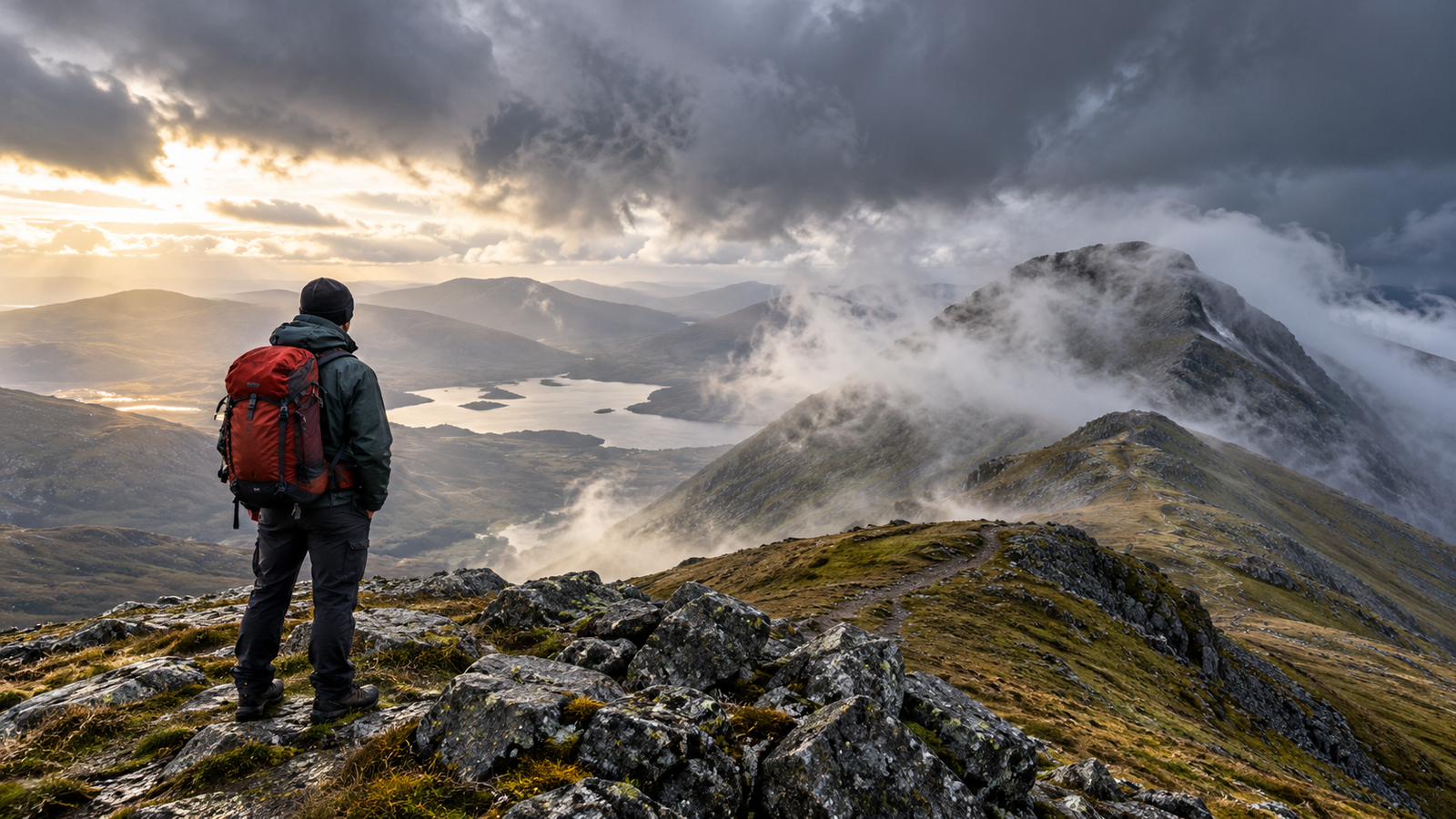
The summit will still be there another day. The important thing is making sure you are too.
In mountaineering, success is often measured by reaching the summit. We spend time researching routes, studying weather forecasts, preparing equipment and travelling long distances, all with one objective in mind: standing at the top of a mountain. But what happens when you have already climbed most of the way and decide not to continue? Is it a failure, a wasted journey, or simply part of becoming a more experienced mountaineer? I found myself reflecting on these questions during my first Munro-bagging weekend in Scotland, when strong winds forced us to abandon our planned ascent of Ben Lawers.
When the Weather Changed Our Plans
On 26 September 2026, I completed my first two Munros, An Caisteal and Beinn a’ Chròin. The following day, we planned to climb Beinn Ghlas and continue towards Ben Lawers. It was an exciting prospect, particularly as I was just beginning my journey towards completing all 282 Munros. However, as we gained height, the wind became increasingly strong, with gusts of around 40 mph. We managed to reach the summit of Beinn Ghlas, but the conditions made continuing towards Ben Lawers a more difficult decision. After considering the exposure ahead and the strength of the wind, we decided to turn back rather than push on towards another summit.
There is something frustrating about abandoning a mountain when you have already invested so much effort in getting there. I had travelled from Leeds to Scotland, organised my weekend, prepared my equipment and spent hours walking uphill. Naturally, I wanted to make the most of the opportunity. When you are attempting a challenge involving 282 mountains, every additional summit feels like meaningful progress, and turning around can seem like losing an opportunity. Yet the mountains have no regard for how far we have travelled, how much money we have spent or how determined we are to reach the top. None of those things changes the weather or reduces the risks associated with exposed terrain.
Determination Versus Judgement
One of the qualities that attracts me to mountaineering is the determination it requires. Long ascents, steep ground, tired legs and uncomfortable weather are all part of the experience. If we abandoned every walk simply because it became physically demanding, we would probably achieve very little. However, I am beginning to understand that there is an important difference between persevering through discomfort and continuing when the level of risk becomes unreasonable. Strong winds can affect balance and movement, particularly on exposed ridges where a stumble or loss of footing could have serious consequences. The decision to continue must therefore take account of the terrain, actual weather conditions, experience of the group and options available for retreat.
What makes these decisions challenging is that there is rarely a single rule that applies to every situation. A wind speed that might be manageable on a broad, sheltered hillside could be far more concerning on a narrow or exposed ridge. Similarly, conditions that an experienced mountaineer might be comfortable navigating could present greater difficulties for someone still developing their skills. On Beinn Ghlas, the decision was not simply about whether we were physically capable of walking farther. It was about whether continuing towards Ben Lawers was sensible given the conditions we were experiencing. Looking back, I believe turning around was the right decision, even though it meant leaving one of our planned summits for another day.
A Different Way of Measuring Success
Before beginning this journey, I tended to associate successful mountain days with completing the planned route and reaching the intended summits. That is understandable, particularly when you have a specific challenge or list of mountains you want to complete. However, the experience on Beinn Ghlas made me think more carefully about what success should actually mean. We had reached a Munro summit, experienced challenging weather, assessed the situation and returned safely. Although Ben Lawers remained unclimbed, the day was certainly not wasted. In many ways, the experience provided a lesson that could prove more valuable than adding another mountain to my completed list.
I am still relatively new to Scottish mountain walking, and I recognise that there is a great deal to learn about navigation, weather interpretation, terrain assessment and decision-making in the mountains. My longer-term ambitions extend beyond the Munros, potentially towards more technical mountaineering and higher-altitude expeditions. Those ambitions will require not only physical fitness and technical skills but also the ability to make sensible decisions under pressure. Being determined is important, but knowing when to reconsider an objective is equally valuable. The ability to turn back should not be regarded as a weakness or a lack of commitment; it is part of developing the judgement needed to operate responsibly in mountain environments.
Another important consideration is that reaching the summit represents only part of the journey. There is still the descent, which can become more difficult as fatigue increases, daylight decreases or weather conditions deteriorate. It is easy to become focused on reaching the highest point while overlooking the effort and potential difficulties involved in returning. A successful mountain day should therefore be measured not only by the summit reached but also by the decisions made throughout the journey and whether everyone returns safely. This is particularly relevant in Scotland, where changing weather and challenging terrain can quickly alter the character of a walk.
Ben Lawers Will Still Be There
I still intend to climb Ben Lawers, and perhaps reaching its summit on another occasion will feel even more satisfying because of this experience. However, I do not see the need to rush back simply to complete an unfinished objective. My journey towards all 282 Munros is a long-term commitment, and I expect there will be other occasions when weather, terrain or circumstances require me to change my plans. Some weekends may involve several successful summits, while others might end without reaching any. Rather than treating those occasions as failures, I want to approach them as opportunities to gain experience and improve my understanding of the mountains.
Ultimately, mountaineering is about much more than collecting summits or ticking names off a list. It is about exploring extraordinary landscapes, challenging ourselves, learning new skills and developing a deeper respect for the natural environment. The mountains offer wonderful experiences, but they also demand patience, preparation and humility. My day on Beinn Ghlas reminded me that ambition should never outweigh judgement and that sometimes the most valuable achievement is recognising when conditions are telling you to stop.
The mountains will still be there another day. The real achievement is making sure we are there to return.
Ben Lawers, I’ll be back.
282 Stories — One Journey, Countless Lessons